When the Gardening Gets Tough

Gardeners go back into the garden!

Touring around the gardening blog world, there are plenty of examples of the hard work underway as we go out In the Garden to prepare for the cold months to come.

I’ve always known that gardeners are hard-working individuals who are passionate about their gardens. As I check the Notes from a Cottage Garden I am reminded that many of these gardeners have been posting their “to do” lists and chores for the garden. Whether the garden is large or a Balcony Garden we can appreciate all of these Garden Endeavors.

Our UK friend at Veg Plotting says "Plot Views - Clearing Needed." The headline sounds like a "Help Wanted" sign and there are so many times I wish I could hire someone to help out with a few arduous tasks. Empathy to the rescue...the comments can be summarized to be very supportive…that’s okay, think of it as wildlife habitat. Now that’s the kind of attitude that I like! Natural areas provide food and cover for wildlife. So, I think I'm going to leave that brush pile of shovel-pruned plants alone for now.

Perennial Garden Lover is quite industrious, providing us with her Fall Checklist tasks. Racquel's list reminds me of my previous life (working for money) where I was a marketing process consultant in product management at a software company. I would take a list like that and put it in a timeline with checkpoints and milestones. Fortunately, we can just skip all of that record-keeping when we’re working for ourselves for free.

At Our Little Acre Kylee reminded me of another task that I don’t do. I delegate the task of birdhouse cleaning to my dear husband because opening up a box at the edge of the woods is just a bit too creepy for me. Call me a whimp, I don’t mind. In cleaning out the birdhouse, Kylee found a Monarch chrysalis, reminding us that wildlife does indeed take advantage of our gardens for shelter intended for other critters. Which reminded me that I want to add a Toadshed to my garden to house my little gardening buddies.

We learn the Secrets of a Seed Scatterer as Jean tells us all about seed scattering and which ones can be sown here in the Southeast. Jean makes this particular task sound like the art of gardening. Well seed …um, said. I’m new to seed scattering and I follow Jean’s guidance in this area.

If you Walk Down the Garden Path with Cindy while she undertakes her fall chores, she takes time to smell the flowers with the other Busy Bees. Cindy has the cutest helper who warmed my heart with memories of sharing the leaf raking chores with my son when he was a little fellow. Kids grow up too fast, don’t they? Cherish the moments.

Allan Armitage gives us some insight into Why We Garden. I believe we can all relate to one of the reasons that Allan brings to light. Dirt Therapy is good for us. Digging rewards us with the Colors of the Garden such as beautiful Lilacs and Roses.

As we pick up the Hoe and Shovel to tackle Clay and Limestone, let us all remember that our hard work now will provide us with a Fairegarden next spring.

Gardens in Art: A Tribute to Artist Eleanor Seng

By Stephen Moore


Eleanor Seng was a Chapel Hill, North Carolina artist known for her expressive color. An art teacher for many years, she introduced countless individuals to the world of art, teaching not just technique but something of what it means to have the spirit of the artist. Many of her students have become professional artists, and two of her sons are professional artists. She studied at Wesleyan College in Georgia with Emil Holzhauer, who was a student of Robert Henri. True to the philosophy of the Ash Can school, Eleanor put life into her art that is imbued with brilliant color and the strength that derives from her traditional training.

Eleanor's interest included landscape, portrait, figurative, and still life. Her work can be found in many private and corporate collections around North Carolina. Eleanor was also associated with the North Carolina Craft Gallery in Carrboro, NC.
Eleanor Seng was my mentor for fifteen plus years. My relationship with her, and art too, began when I was in the fifth grade taking community art classes in a dusty old Victorian house. She taught me and many others what we know about art, art history, and so much more.

Eleanor Seng passed in 2008 and will be missed by many.

To see additional art by Eleanor Seng, please visit Tarheel Gallery.


The Gardens in Art series features North Carolina artists

Google Garden Clippers

Every gardener uses clippers, right?

Well, this clipper isn't a tool that you'll take out into the garden. However, it is a tool that I believe you may want to use on a daily basis.

How often do you surf the Web looking for information about a specific plant, either text or photos? I know that I often look for growing conditions for a plant as well as suitable companions. When comparing prices, I need a way to quickly note the prices across vendors. I want to store all of this information in one place, conveniently organized and easily accessible.

With Google Notebook you can clip, store and organize the information. I use Notebook for gardening--as well as making travel plans, capturing information (like phone numbers) and gathering research for my writing. You don't need to be a computer expert to use this tool. It's fairly easy and straightforward. The help information is quite good.

As with so many Google products, Notebook is another software product that is free. All you need is a Google userid. A userid is easy to create from the Google Search page. If you have a blog on Blogspot or a Gmail account, then you can use the same userid.

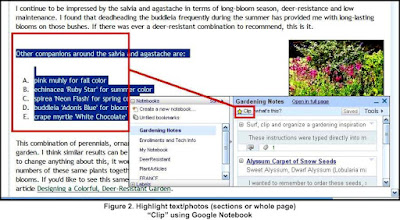
Once you have installed Notebook, a little "blue notebook" icon will show up at the lower right corner of your browser screen. Whenever you click that little Notebook, you've got your tool -- it's always there, always ready to be used unless you decide to close it down. (Click on the images to view larger as a slideshow)


Found an article you like?
  • Use your mouse to highlight the text and photos that you want to clip and save.
  • With the information highlighted, click on the Notebook icon.
  • Click on "Clip."
  • You have just stored information in your Notebook.


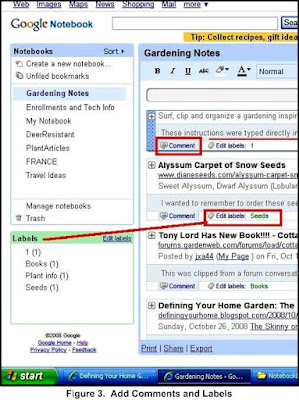
  • You can add a comment to each of your clippings so that you know why you saved the information.
  • You can also add labels (a category) so you can sort and filter your information.


Once you have used labels, you can sort your information by those categories. For example, as you clip information, it is stored in the order in which it is clipped. By using the "sort by label" function you can group all information in the same category together for better organizations.

You can Print, Share or Export your notebooks. I have shared my example notebook by publishing it to a web page. I could have sent out email to friends to invite them to view the page while keeping the notebook private from others. With the invitation, you can collaborate and allow your friends to edit the information. By publishing, the world can read your notebook; click through the links; but, they cannot edit your information.

I believe that Google Notebook will save you so much time as you gather, store and organize your gardening information and inspirations. You won't lose these clippers and they never need sharpening. Now, start clipping!

Google trademarks, copyrights and images within my screenshots of Google Notebook are owned by Google.