The display of three boats planted with colorful annuals was spotted during a lunch stop in the French village of Martigues, located thirty minutes southwest from the Marseille Airport. Martigues is on the Canal de Caronte, a waterway that connects the Etang de Berre with the Golfe de Fos and the Mediterranean Sea. Martigues is made up of three villages, Jonquières, L'Isle, and Ferrières, that merged into one community around 400 years ago. Each boat bears the name of one of those villages.
Could this be an idea for a Fathers' Day surprise—from a gardener to her fisherman/gardener dad or husband? Words and photos by Freda Cameron, Defining Your Home, Garden and Travel. All company or product or patented names mentioned are registered trademarks, copyrights, or patents owned by those respective companies or persons. |
Showing posts with label Europe. Show all posts
Showing posts with label Europe. Show all posts
Garden Inspiration: Does This Container Garden Float Your Boat?


Garden Inspiration: The Bane of Rabbits?
 |
| Could this be doronicum orientale? Found in a Paris park (Champs-Élysées); April 2011 |
While in Paris in April 2011, strolling in a park off the Champs-Élysées, I was drawn to a mound of yellow flowers. Beautiful, perfect blooms glowed in mass planting in partial shade.
Researching the web, I decided this flower must be Leopards Bane (doronicum orientale). The perennial, being a native of Europe and Asia, supposedly acquired its name as a repellent of wild animals. In particular, rabbits! Could it be true?
I'm sure there's some catch—perhaps the plant can't handle the humidity of the South? I've never seen this sunny flower around here, though it is said to be suitable for zones 4a-8a. Even without rabbit repelling qualities, the flowers are stunning!
 |
| Do you think they run the rabbits out of Paris parks? Non, pas possible—they were far too nice (flirting). Bonjour and smiles. |
 |
| Or, could it be that Leopards Bane keeps the rabbits away? |
| Words and photos by Freda Cameron, Defining Your Home, Garden and Travel. Deer and rabbit resistance varies based upon the animal population and availability of food. All company or product or patented names mentioned are registered trademarks, copyrights, or patents owned by those respective companies or persons. |
You Can't See the Village for the Market
 |
| A kaleidoscope of colors at the Aix-en-Provence flower market. April 2011. |
After spending nine days in Paris in April, I looked forward to a week in the village of Aix-en-Provence. Aix is a convenient base for accessing the surrounding area—the Provence countryside and Luberon villages, the Mediterranean coast, the western French Riviera and the Camargue—no more than a two hour drive in any direction.
One of the most famous and popular markets in the region of Provence takes place in the lovely village of L'Isle-sur-la-Sorgue. A river literally runs through the picturesque village.
My first full day in Provence was a Sunday and perfectly timed for the not-to-be-missed market day in L'Isle-sur-la-Sorgue! I saw the antique stalls, the spices, the fabrics, the flowers and everything else at the market.
 |
| Sunday market day in L'Isle-sur-la-Sorgue in Provence, France. Vendor stalls line both sides of the river. April 2011. |
After spending the morning browsing the market and enjoying lunch of chilled wine, fresh veggies, cheese and strawberries, it was time to take to the winding country roads. Driving past vineyards and rolling hills there were many choices for the rest of the day, but I opted to visit the villages of Bonnieux and Goult.
These two Luberon villages were sleepy and practically empty on that Sunday afternoon. Wandering the cobblestoned streets, climbing rocky and precarious steps for vistas, it was a perfect day for getting lost in the maze of village houses. I could hear the laughter and attempt to eavesdrop on the French conversations among the locals as I passed the cafes.
Later in the week, I visited the bustling markets, in particular the flower market, in my "home village" of Aix-en-Provence. It was after the flower market that I learned a valuable lesson. I visited the flower market in the morning, then walked to a nearby cafe for a leisurely lunch indoors, out of the rain.
After lunch, the sun was out and as I walked through the Place de l'Hôtel de ville again, the flower vendors were gone and the square had taken on a whole new vibe. Cafes and conversations. Strolling couples, families and friends.
When the market packs up at the end of the day, the ambiance is entirely different. I've blindly traveled for years without stopping to appreciate this remarkable transformation.
 |
| Aix-en-Provence flower market on a rainy April morning. |
 |
| A few hours later, the market is gone and the same square is a cafe scene. Aix-en-Provence. April 2011. |
While the market was extraordinary, I am left with a feeling that perhaps I missed something even more extraordinary.
| Words and photos by Freda Cameron, Defining Your Home, Garden and Travel. All company or product or patented names mentioned are registered trademarks, copyrights, or patents owned by those respective companies or persons. |
Lilacs are Here, There and Everywhere
 |
| Lilac 'Miss Kim' in full bloom in my home garden. Chapel Hill, North Carolina; April 2011. |
It has taken four years for my 'Miss Kim' to bloom abundantly. I first planted her in full sun and she toasted in summer. I transplanted her to a space between two tea olives (osmanthus fragrans) to give her some shade. Between the fragrance of the lilac and the fragrance from the tea olives, the combined perfume is very heavy and can be enjoyed from all area of my garden. Not unlike walking into a department store and being overcome by the scent of hundreds of perfumes!
Another reason why I squeezed 'Miss Kim' in between the evergreen tea olives is because she gets to be a bit dowdy looking when not in bloom. So, I let her bloom. Take her photo while she is stunning, then cut the panicles of perfume to bring indoors.
Lilac 'Miss Kim' (syringa pubescens susp. patula)
zones 3a-7b
4-6 feet
full sun (partial sun is better in the warmest zone)
While visiting JC Raulston Arboretum in mid-March, I found 'Miss Kim' blooming along with a cutleaf lilac (syringa x laciniata). The cutleaf lilac has an open, airy form and is taller and looser in structure.
Cutleaf lilac (syringa x laciniata)
zones 4-8
6-10 feet
full sun
 |
| Cutleaf lilac at JC Raulston Arboretum. Raleigh, North Carolina; March 2011. |
 |
| Blooms of cutleaf lilac. |
 |
| Lilac in full bloom in Jardin des Plantes. Paris, France; April 2011. |
| Words and photos by Freda Cameron, Defining Your Home, Garden and Travel. Deer and rabbit resistance varies based upon the animal population and availability of food. All company or product or patented names mentioned are registered trademarks, copyrights, or patents owned by those respective companies or persons. |
Home Again (from France)
 |
| Notre Dame Paris; April 2011 |
As for writing about the garden here at home—after I do a lot of weeding...
| Words and photos by Freda Cameron, Defining Your Home, Garden and Travel. |
More of Monet's Gardens at Giverny?
Spring is in the air and gardeners anxiously await the first blooms in the garden. To boost my enthusiasm, I peruse the volumes of garden photos that I've taken in the springtime—my own garden as well as those that I have visited.
I always find myself studying the hundreds of photos that I took at Claude Monet's gardens at Giverny, France in May 2009. Are you ready for more Monet?
We're returning to France in April 2011. Monet's gardens in early April will be filled with tulips and other spring bulbs. Will we take the train out of Paris for a return trip?
Sometimes seeing less can reveal more—as in the bones or structure of a garden that may be hidden behind the billowing blooms in peak season.
I may be ready for another Monet moment.
I always find myself studying the hundreds of photos that I took at Claude Monet's gardens at Giverny, France in May 2009. Are you ready for more Monet?
 |
| Monet's Gardens at Giverny, France The Clos Normand, May 2009. |
 |
| Looking through a veil of purple. |
 |
| The beautiful Tamarisk tree (can be invasive in some areas). |
 |
| Perfectly planted in pink. |
 |
| Lawn and garden merge. No doubt the foliage of spent daffodils in the grass. |
 |
| Another Monet moment? |
Sometimes seeing less can reveal more—as in the bones or structure of a garden that may be hidden behind the billowing blooms in peak season.
I may be ready for another Monet moment.
| Words and photos by Freda Cameron, Defining Your Home, Garden and Travel. All company or product or patented names mentioned are registered trademarks, copyrights, or patents owned by those respective companies or persons. |
GGW "On the Road" Photo: Monet's Garden
Deciding which photo of Monet's Garden to use for the Gardening Gone Wild Photo Contest for August 2010 was difficult. A view of Monet's house, as well as the mix of flowers, reminds me of the Impressionist's paintings.
The photo was taken on a cloudy day in May 2009 in the Clos Normand (walled garden) section of Monet's Garden in Giverny, France.

The photo was taken on a cloudy day in May 2009 in the Clos Normand (walled garden) section of Monet's Garden in Giverny, France.

| Words and photos by Freda Cameron, Defining Your Home, Garden and Travel. All company or product or patented names mentioned are registered trademarks, copyrights, or patents owned by those respective companies or persons. |
For the Love of Lavender

I love to buy lavender soap and bouquets of dried lavender at French markets.
(Antibes, France; May 2010)

I love to use lavender as a centerpiece to fill the air with fragrance.
(Antibes, France; May 2010)

I love to see lavender growing in fields.
(Sunshine Lavender Farm, North Carolina; June 2010)

I love to learn about lavender planting from Annie Greer Baggett.
(Sunshine Lavender Farm; June 2010)

I love to eat lavender ice cream made by Maple View Farm.
(Sunshine Lavender Farm)

I love to bake lavender scones at home.
(home kitchen, Chapel Hill, North Carolina; December 2008)

Most of all, I love to grow lavender for the wonderful honey bees.
Our neighborhood lost two wild bee hives over the winter. One hive is being rebuilt.
My garden is far too quiet this year without all of the honey bees.
(home garden, Chapel Hill; April 2009)
Words and photos by Freda Cameron, Defining Your Home, Garden and Travel. All company or product or patented names mentioned are registered trademarks, copyrights, or patents owned by those respective companies or persons. |
Just Being There. That's All.
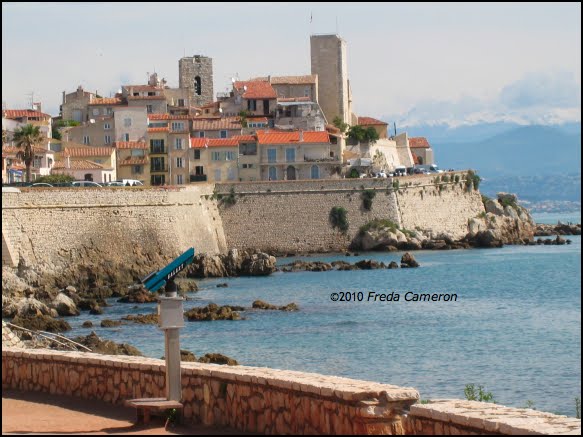 Just being in a village in France was the reason for our vacation. We shopped the market. Had espresso on the balcony each morning. A pair of doves visited us daily. We washed clothes and hung them to dry on the lines outside our windows. We walked and hiked—a lot. Simple. Wonderful. The Old Town of Antibes.
| Words and photos by Freda Cameron, Defining Your Home, Garden and Travel. |
Antibes
Antibes is a lovely village. Our apartment is fabulous and we enjoyed a baguette and made espresso for breakfast.
In France, there is so much to say about fresh food.
This morning, we went to the Provincal Market where we bought spices, veggies, etc to make dinner. We bought a bouquet of dried lavender and lavender soap for the apartment. We then walked for an hour along the coast to Cap d'Antibes. We had lunch at La Roche by the beach at La Garoupe. We dined there on our trip two years ago.
After a walk out on a point in the bay, we walked back. After two hours of walking, we think we deserve to eat well!
Enjoy your weekend--the weather here is lovely. I wish I could post photos from today!
| Words and photos by Freda Cameron, Defining Your Home, Garden and Travel. All company or product or patented names mentioned are registered trademarks/copyrights/patents owned by those respective companies or persons. |
European Garden Envy
It's for the sake of research. At least that's my rationalization for adding new plants to the deer resistant garden. To be perfectly honest, I have a case of "European Garden Envy."
There's a subscription card to BBC Gardens Illustrated sitting in my kitchen, waiting for me to give in to the temptation. That's one of my favorite garden eye candy magazines. Several times a year, I purchase a copy off the rack. I also pick up The English Garden when I can find it. If the French had equivalent magazines available in this country, I'd pick those up, too. Maybe it would help with my understanding of the language.
The reality is that I live in North Carolina, not Europe. Gardeners living in the Pacific Northwest have suggested that those with my affliction move there if I want to grow an English Garden. To be clear, North Carolina gets more measured rainfall than Seattle, we just have more sunny days. We have humidity and hot summer nights—the usual reasons why some of those plants won't like living in my garden.
There are a few plants that I just couldn't resist trying this year. I may be violating the rule of "right plant, right place." However, I'm willing to gamble. Perhaps these are the right plants for my garden?
 After my visit to France last year, I started lusting after the French Blue ceanothus (California Lilac). I had dreams about this gorgeous blue shrub.
Imagine my delight to find a mail-order nursery, Lazy S'S Farm in Virginia, that carries several varieties of ceanothus! Ceanothus thyrsiflorus 'Victoria' is now planted in my garden.
English lavender 'Vicenza Blue' and stipa 'Ponytails' (purchased from a local nursery, Multiflora Greenhouses) are the companions to my ceanothus.
All of these plants have low water requirements, prefer well-drained soil, can withstand hot sun and are deer resistant.
Ceanothus thyrsiflorus 'Victoria'
zone 7-9
height 6-9 feet
Lavandula angustifolia ‘Vicenza Blue’
zones 5-9
height 10-12 inches
Stipa tenuissima 'Ponytails'
zones 7-10
height 24-36 inches
Stipa, or Mexican Feather Grass, was featured in several stories in the English magazines and caught my attention. The swaying softness, the short size for an ornamental grass are desirable traits. I decided to give the grass a try here after reading about gardeners in similar zones using stipa. It is possible for this grass to be invasive in some states, so check the invasive species list in your region before planting this grass. Deadhead to prevent seeding.
Several varieties of lavender are grown here in my garden, but the 'Vicenza Blue' is supposed to be short (10-12 inches). Finding a compact size is the big attraction as I have grown monster lavenders in my garden! If this one is easy to grow and is short, then I have more uses for this lavender.
Only time will tell if I am successful with my "research" to satisfy my European Garden Envy.
| Words and photos by Freda Cameron, Defining Your Home, Garden and Travel. All company or product or patented names mentioned are registered trademarks/copyrights/patents owned by those respective companies or persons. |
Bold Brushes of Color in Monet's Garden
 Which came first — the art or the garden? Impressionist artist, Claude Monet was first an artist. When he moved to Giverny, he became an obsessed gardener. His garden was designed not only for his enjoyment as a gardener, but as a subject for his paintings.
Monet's Gardens at Giverny have been reconstructed from his paintings, over 500 of which were based on his gardens. Pastel colors are abundant, but there are also swaths of bright yellow, orange and red. The photos shown here were taken in the May, but the garden colors and flowers change with every season.
Tulips, wallflowers and pansies provide much of the bold color in the spring gardens inside the walled gardens, named the Clos Normand, at Giverny.

One of my favorite books is The Impressionist Garden by Derek Fell. Given to me so many years ago, this well-worn book served as inspiration for my gardens as I dreamed of someday visiting the gardens in France.
After visiting Giverny in May 2009, I found the courage to try the bolder colors in my garden. I set about rearranging plants last fall and eagerly await the first results this summer. Mind you, I'll never have a Giverny, but in small vignettes through my borders, I have planted little pockets of orange, red, yellow and gold.
Not having the same space, place or climate, I look for substituting plants of the same colors, but not necessarily of the same variety or used in the same season. My spring colors are still based upon the pastel colors of purple, blue and pink. But, my summer and fall color scheme in 2010 will include colors inspired by Giverny.

I have planted a swath of bright orange and gold gaillardia at the feet of red monarda 'Jacob Kline' that is set among salvia greggii 'Bright Navajo Red' and crocosmia 'Lucifer'. Marigolds in orange and zinnias in soft golden yellow will be sown as seeds when the soil warms up in the spring. The deep green foliage of osmanthus fragrans and white oleander serve as a buffer between this vignette and another.
The deep red tulips planted at the edge of Monet's Water Garden are stunning paired with green foliage of irises, planted beneath a weeping tree. This is a color combination that I'd also like to replicate using red geum. I planted my first geum in summer 2009 and will see how well it overwintered and if it continues to be deer and rabbit resistant.
My pineapple sage, when in bloom beside the clumping bamboo, is the closest that I've come so far in achieving the red and green duo. If you don't have deer or rabbits, you can probably come up with many more possibilities!

One of the most beautiful flowering shrub displays at Giverny in May was the clustering of soft apricot-orange and bright red azaleas with a Japanese Maple. This is a combination that can be tried by studying the colors available in the rhododendron family until you get just the right colors to work with the burgundy foliage of the maple.
Native azaleas come to mind as good options for the edge of woodlands. Rhododendron austrinum (Flame Azalea) is a flashy orange-flowering native for USDA zones 6-10; part sun to shade in moist soil.
Behind this color scheme, large trees divide the bright colors from the soft, lavender panicles of wisteria growing on Monet's bridge, trellises and arbors around the pond.


Proving that not all garden color has to come from plants, this big rooster proudly holds court at the entrance to Monet's Clos Normand!

Location: Giverny, France; May 2009; Words and photos by Freda Cameron, Defining Your Home, Garden and Travel. All company or product or patented names mentioned are registered trademarks/copyrights/patents owned by those respective companies or persons.
The Pastel Palette of Monet's Garden
 Look to Monet's Gardens at Giverny, France for true cottage garden inspiration. Spring-blooming bulbs, perennials, annuals and vines are used liberally in a garden that is literally stuffed so full of flowers that no ground is visible. Pebbled garden paths add to the inviting, casual style. Soft spring colors of pink, purple, white and blue are soothing and tranquil.
Elements from these famous, but unpretentious French gardens can be translated for use at home. The plantings aren't suitable for every growing zone, but the pastel color palette provides wonderful examples of how to use shapes and heights together in random beauty.
Billowing wisteria drips over Monet's water garden, a signature plant for many of his paintings. The wisteria wraps the arched Japanese bridge as well as arbors and trellises that accent the winding paths around the water's edge. Although the fragrant wisteria sinensis is truly glorious, careful control is necessary or it will take over native plants and entire woodlands.
 The dainty pink tulips, planted as bulbs in autumn, are underplanted with annuals such as pansies and self-sowing myosotis sylvatica (forget-me-nots). Since tulips bloom best during the first spring, they are often regarded as annuals and replanted each year. Tulip 'Pink Impression' is a good choice for replicating this vignette.
 Purple alliums are bulbs to plant at the same time as tulips. For home gardens, a good choice is allium 'Purple Sensation' randomly arranged in a mass planting among companions. Hardy geraniums such as 'Rozanne' and Dutch iris 'Rosario' work well as perennial partners. Poppy 'Angels Choir' and nigella 'Mulberry Rose', easily sown from seed, are good annual choices for the home garden, too.
 Vertical displays of blooms are evident throughout the walled gardens of the Clos Normand. Bowers of pink and white clematis scramble over arbors in Monet's gardens. Clematis 'Pink Fantasy' and 'Guernsey Cream' are candidates for recreating the look. Flowering trees and shrubs at Giverny include tamarisk, pink dogwood, lilac, and apple. Meandering plantings through meadow grass provide calm expanses beneath the orchard trees.
Colors, paths, accents and plants — there is much to inspire gardeners and artists!


Bright blooms are also used in Monet's spring color scheme around the pond and within the walled gardens. Next time...
Location: Monet's Gardens at Giverny, France. May 2009. Words and photos by Freda Cameron, Defining Your Home, Garden and Travel. All company or product or patented names mentioned are registered trademarks/copyrights/patents owned by those respective companies or persons.
Paris - The City of Love for Dogs
 The City of Lights is also The City of Love. But, it's not all about lovers kissing passionately on the romantic bridges. My non-scientific observation is that Parisians really, really love their dogs. You can tell that the dogs are real sweethearts!
Dogs are literally everywhere you look - streets, shops, handbags, cars and restaurants.
 While walking in the Luxembourg Gardens, an elderly lady picked up her precious pup, kissed her and placed her in her large handbag. Hair coiffed in a perky Paris style, my photo thrilled the little dog's owner.
A petite Italian Greyhound, donned in a stylish collar and coat, had her own matching blanket to lie upon while dining indoors at a fabulous cafe. As thin and trim as a runway model wearing the latest haute couture, the fabulous dog shunned my attempts at puparazzi when we passed later on the street.
Just like movie stars, dogs know when you're trying to take a photo and look away. I had to adjust my photographic maneuvers in order to capture my subjects unnoticed. With a great zoom lens and a swivel viewer, it was easy to keep my camera low as I photographed the canine companions.
 |  |
Don't be fooled by the prissy pupulation. Not all of the dogs were decked out in haute couture. Most dogs, sans fancy collars, hairstyles or coats - wore standard leashes or were freely working at their owner's shops. It is clearly a culture where dogs are considered family members. They live indoors. With all of the walking on city streets and parks, the dogs must get plenty of exercise, just like their Parisian owners.
Paris is The City of Lights and The City of Love. Many Parisians wear their hearts at the end of leashes!
 |  |
 |  |
It's fun to watch dogs, shoot dogs (with a camera) and garden with dogs.
For the love of dogs everywhere, please take time to review and bookmark this list of toxic plants provided by the American Society for the Prevention of Cruelty to Animals (ASPCA).
♥♥♥♥♥
Words and photos by Freda Cameron, Defining Your Home, Garden and Travel.
Subscribe to:
Posts (Atom)