Hardscape in the Garden

Aside from gardening with plants, most gardeners are interested in having structure and interest in the garden or landscape.

The fall and winter months provide a great time for building projects such as patios, walks, stepping stones and other “hardscape” projects for the garden. Not only are the bugs and snakes gone, but the temperatures are cooler.

Over the years we have used a professional landscaper for some projects while taking the DIY route with other projects. How did we decide? If the project requires special heavy equipment or if the materials are beyond our ability to handle safely, we hire a professional. We have used the same professional landscaper at our previous home and our current home.

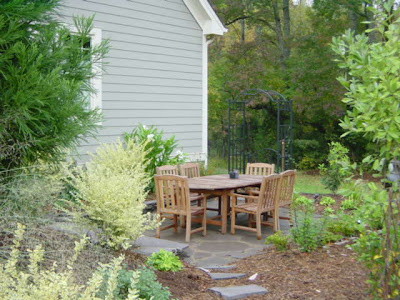
One of our family projects last fall was the building of a dining patio. One son (an archaeologist) dug out and leveled the ground for us. He also helped build the garden beds, including the planting of the shrubs and trees. The other son (a pharmacy student) laid the flagstone and the retaining walls. I designed and drew the plan, calculated and order materials. My husband assisted with the heavy lifting and breaking of the flagstone.

We used polymeric sand in the joints between the flagstone for our walk and one patio. It's made by Techni-seal and is used for dry-laid projects. It's a sand product with polymers that make it harden so that you don't have to keep sweeping sand or screenings between the stones. I did our patio one morning all by myself.

This photo was taken right after the patio was completed. It is already much more lushly planted. Even more, there is now a backyard swimming pool accessible through the arbor.

Vines on the arbor include jasmine and akebia. There is a sweet bay magnolia, ginger, winter daphne and gardenias for additional fragrance during different seasons.


Less difficult projects included laying stepping stones or adding garden benches and accents.

Before beginning any difficult project, we always purchase a book to help us understand the preparations, instructions and tools needed. Sometimes the information can be found online or by asking others. Still, having a book for a reference has been very helpful. If, after reading how to DIY the project, you feel overwhelmed, then perhaps it's time to call in a professional landscaper for help.

This is also a great time to find outdoor garden accessories or accents on sale. We purchased a large market umbrella for half price. We also purchased a teak and stainless outdoor shower to use with our swimming pool. We never would have purchased these items at full price. Planters, benches and other accents are often on sale this time of year.

I've also found that winter is a great time to find gardening books on sale. With the holiday season, there may also be offers of free shipping if you are purchasing online. Sitting by the fire sipping coffee or tea on a cold winter's day is a great way to plan your garden projects for spring and summer.

Happy Gardening!
Cameron

Favorite Small Trees

I'm often asked about my favorite small trees. Here's a list of those that I like the best with a bit of information about each.

For different textures I like to mix deciduous, ornamentals and evergreens.

There are some clumping bamboos, like Bambusa glaucescens 'Fernleaf' which grow to 10x6. They sway in the breeze, the birds love to hang out there, they are evergreen.

Osmanthus fragrans is a wonderful evergreen, fragrant shrub that grows to 25x15.

Cryptomeria japonica 'Sekkan Sugi' 30x15, has very graceful needles.

You can mix these evergreens in with some ornamentals:

magnolia virginiana: sweetbay magnolia, semi-evergreen, fragrant blossoms in March. Can take wet feet or not. 30x20

Chionanthus retusus: Chinese fringetree, deciduous, fragrant in May/June, well-drained soil. 20x15.

Evodia danellii : Korean Evodia, deciduous, average/fast growth, white flowers in summer, red fruit after. 30x30.

Franklinia alatamaha: Franklin tree, deciduous, fragrant July/August white flowers. 20x15. This one may be best for the experienced gardeners.

hepaticodium miconiodes: seven-son shrub, deciduous, fragrant white flowers. 20x10 \

Vitex (chaste tree); very drought tolerant and great in a butterfly garden

Large buddleia (butterfly bush); very drought tolerant and highly attractive to butterflies.

Betula nigra Fox Valley™ 'Little King' is 10x12.

Cercis canadensis 'Covey' is a weeping form 6x8.

Magnolia x 'Ann' is 10x10

Prunus x 'Snow Fountain' is 10x15.

D4-Exceptional Drought (rethink our landscapes)

Our county is one of the many in North Carolina in stage D4-Exceptional Drought. This is worse than D3-Severe Drought. You can track the drought at NC Drought.

The impact and damage is at many levels: water supplies, native plants, landscapes, gardens and those who earn their livelihood at professions that rely upon water such as nurseries that keep plant inventory. Some public water systems allow new landscape for new construction to be watered for 30 days. However, there is no way to know what rain will fall after those grace periods. Therefore, the builders and homeowners are running the risk of losing whatever they have planted. With no possibility of rain in the forecast for another five days, we are faced with new challenges that we have not experienced in this area in a very long time, perhaps in my lifetime. I’ll have to do some more research on past droughts for an accurate history.

We no longer use weekly drip irrigation for the few plants that were on our system as we can’t be assured as to the water level of our private well. If some of the surrounding water systems have only 80 days of water supply left, what does that mean for private well owners? It will vary from site to site, of course.

We are keeping buckets in our showers to collect water before the water turns hot. We are collecting pots of water in the kitchen as well. This water is providing selective watering to plants and shrubs that would be very expensive to replace. Otherwise, the garden is going to have to survive on its own. In the last few weeks I’ve noticed that the morning dew has been heavy. This small amount of moisture is actually providing some benefit to the garden.

This week I set about checking for dead plants. I could literally pull some of these out of the ground without digging. I dug down into the soil in several places. Our garden is heavily mulched. The soil is dry. It is too dry to plant anything. In the lowest places, I found some moist soil still down below the mulch.

That’s the bad news and a big wake-up call about this precious resource. We can learn from other parts of the country that experience drought or low-water conditions on a regular basis. Xeriscape™! The best resource that I have found to explain xeriscape is Colorado WaterWise Council.

In a nutshell, the site explains the principles of xericaping your lawn and garden (paraphrasing the Colorado source):

1. Plan and design from the beginning for water conservation and beauty
2. Create practical turf areas of manageable sizes with appropriate grasses
3. Select low water plants for your zone and soil conditions
4. Use appropriate soil amendments such as compost
5. Layer mulches to retain moisture and prevent evaporation
6. Irrigate efficiently with the right amount of water at the right time
7. Maintain the landscape


Please take time to visit the Colorado WaterWise Council site to understand their suggested Xeriscape™ Colorado principles. I have posted many blogs regarding drought tolerant plants for our zone. I will continue to provide drought, deer and butterfly gardening updates.

With good xeriscaping principles we will save water and continue to create beautiful gardens for our homes.

Happy Xeriscaping!

Cameron

Xeriscape™ and the Xeriscape logo are trademarks of Denver Water.