The Love-Hate Relationship with Aggressive Perennials


To one gardener, an aggressive perennial can be a thug and it becomes a plant that you love to hate.

To another gardener, the same aggressive perennial can be the perfect plant for the garden and you hate to love it.

Salvia uliginosa (bog sage) is suitable for a rain garden. I bought just one plant in 2007 and plopped it front and center. In spring 2008, there were runners going in every direction for about three to four feet from the mother plant.

If this had been an Olympic garden event, these runners would have won gold medals for their speed.

At the same time that I planted the one bog sage, I also planted six tiny seedlings of eupatorium coelestinum Wayside (hardy perennial ageratum) in the rain garden.

By spring 2008, there had been a major population explosion too high for an accurate census count.

I'm sure some gardeners would be cursing and pulling these plants out of the garden. I was happily dancing a jig as I distributed the offspring of these full-sun, moisture-loving, drought-surviving, deer-resistant, rabbit-resistant, BLUE perennials throughout my rain garden.

In defense of the aggressors, there are other good attributes, too.

Bog Sage reaches four feet in height with swaying wands of azure blue flowers that are magnets for bees and butterflies. It is suitable for zones 6-9. It can grow in moist or dry soil. Mine bloomed non-stop from early June and into fall. Right now, in winter, the base foliage is still green.

There's something amazing about the bog sage. Every evening (under the influence of wine) as I took my garden walk, I would tell myself to deadhead the bog sage the next morning.

Every morning (under the influence of coffee), I was amazed that the azure blooms had re-emerged without deadheading. I need to put a slow-motion video on these plants to determine whether they are closing up in the evening, or actually growing new flowers overnight!

Hardy Ageratum is short at around 15" so it works well for the front of the border and is loved by bees and butterflies. It is suitable for zones 5-8.

During the summer, the foliage is very pretty. By mid to late summer through early fall, it blooms profusely, much like the annual variety of ageratum.

The blue color works well with many other colors such as yellow, orange, red, pink or magenta. It's suitable for clay soils, but mine is growing in rich, garden soil.

In the spirit of full disclosure, I have a lot of space that needs fillers and it will take a few years for me to reach my limit on the sage and ageratum.

These two aggressive perennials were very easy to pull (so far). The runners of the bog salvia were so shallow that I just snipped and pulled them off the soil to move to other locations. I moved the ageratum throughout the summer by easily scooping underneath the little seedlings.

If you want to add these two accused thugs into your garden, you'll just have to decide whether to keep them confined within walls of a container or let them wear ankle bracelets and roam your garden.

Photos and story by Freda Cameron

Winter Daphne for Winter Blooms

Winter Daphne, or daphne odora, is a beautiful, evergreen shrub that few gardeners attempt as it has a reputation for being difficult to grow. I hesitate to even write about daphne for fear of jinxing my luck and "Daphne Death" will strike my garden.

This daphne is planted in filtered shade on the north side of a sweetbay magnolia in the fragrance garden. The garden is located on the east side of the house. I believe the protected location may have a lot to do with the survival of the daphne.

There was a daphne twin on the south side of the magnolia that toasted in the drought of 2007 as there wasn't sufficient shade. I had added a colocasia for quick shade, but the effort was too late.

The garden was created in fall 2006 and the shrub and magnolia were planted at the same time by my son. My son is an archaeologist, so he knows how to dig perfect holes! I'll admit that I was hovering over him making sure that he planted the daphne on top of a volcano-shaped mound of soil for good drainage. He's actually quite knowledgeable about plants and gardening. (Of course, he learned most of it from me.)

Last winter, this daphne bloomed through January and into February. It was so heavily laden with blooms that the shrub started to splay open-- badly. I was worried that it would break, but it held on until it was warm enough in March to do a bit of shaping and pruning. As you can see in both photographs, the ends of the branches quickly leafed out with pretty foliage. I tried to maintain the naturally rounded shape of the daphne.

Daphne is suitable for zones 7-9, is evergreen and does best in filtered shade with well-drained soil. The height and width is around 4 feet. While other plants in my fragrance garden are on drip irrigation, I have never provided supplemental water for the daphne beyond getting it established and little water through the long drought of 2007. I think planting in the fall is better than spring planting to get this shrub established.

My daphne odora is located in the fragrance garden because it is very fragrant! It would be perfect to plant daphne beside a frequently used door to your home. I visit the daphne on sunny winter mornings, but would love to have one where it could be enjoyed more often.

Go ahead and live dangerously -- try a daphne in your garden.

Photos and story by Freda Cameron
Favorite Perennial: Nepeta

Nepeta is one of those perennials that seems rather ordinary, but it works so well in many situations, that it is one of my favorites and worth modifying a past story about this tough player.

Throughout my garden, I've used nepeta extensively. It was the first perennial that I found to be truly deer and rabbit proof. However, I've come to love it for so many reasons other than pest free attributes.

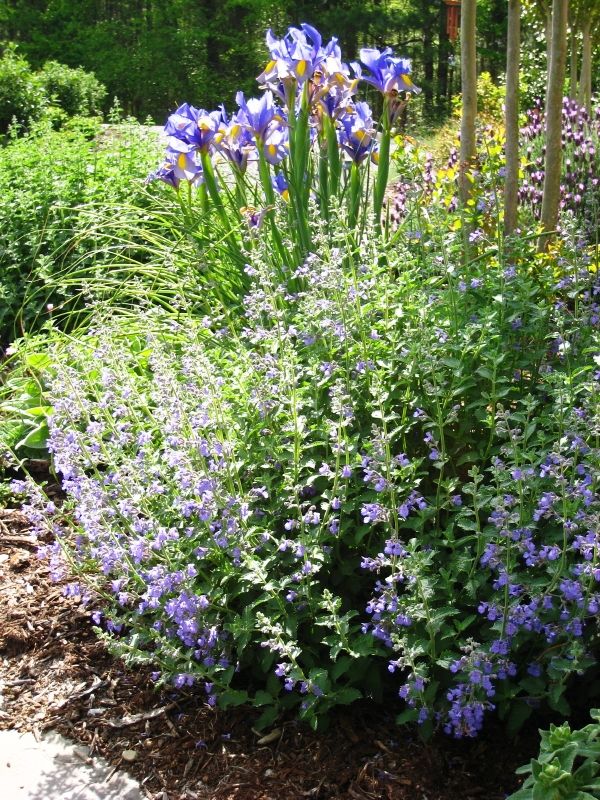
The lavender-blue blooms of the 'Six Hills Giant' or 'Walkers Low' Nepeta work well with almost every color combination. The color also works well to provide a break between clashing colors in a garden. The grey-green foliage has a spicy fragrance and mounds beautifully all summer long if sheared between blooms. The easiest way to shear nepeta is using cordless trimmers.

Nepeta 'Six Hills Giant' blooms early enough in April to have some overlap with Dutch Iris. Since this nepeta is large and frilly, it also serves to hide the Dutch iris foliage after the flowers are gone.


I seem to always underestimate the amount of space needed for nepeta 'Six Hills Giant' or 'Walkers Low'. If you grow either one of these, leave at least three feet of space for each plant. You can divide the nepeta when they first begin to emerge in early spring. Just take a shovel and cut out a section, then backfill the hole with soil.

'Six HIlls Giant' is taller than 'Walkers Low' and creates a larger mass. 'Walkers Low' is more like a flowering ground cover.

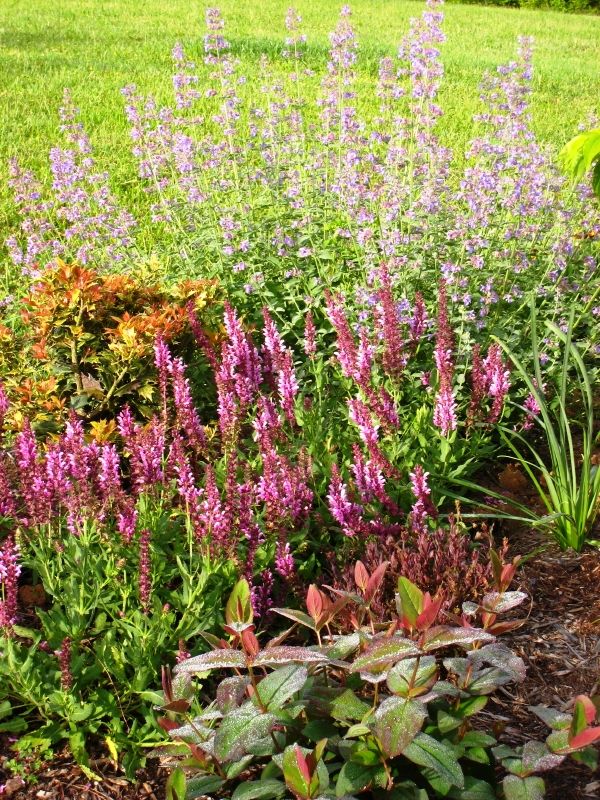
In the next photo, nepeta 'Six Hills Giant' is serving the purpose of dividing up color schemes in summer 2008. This fall, I moved the rose pink salvia and to another location and replaced them with three agastache 'Coronado' which is an apricot color.

Just to the left of the nepeta is an osmanthus goshiki shrub that has tinged bronze new growth. The evergreen osmanthus will be yellow and green after a few weeks in summer.

The rosey plumes are salvia 'Rose Queen'. In front is a hypericum 'Albury Purple'. I love the foliage of the hypericum, but the success rate has been mixed with that variety.


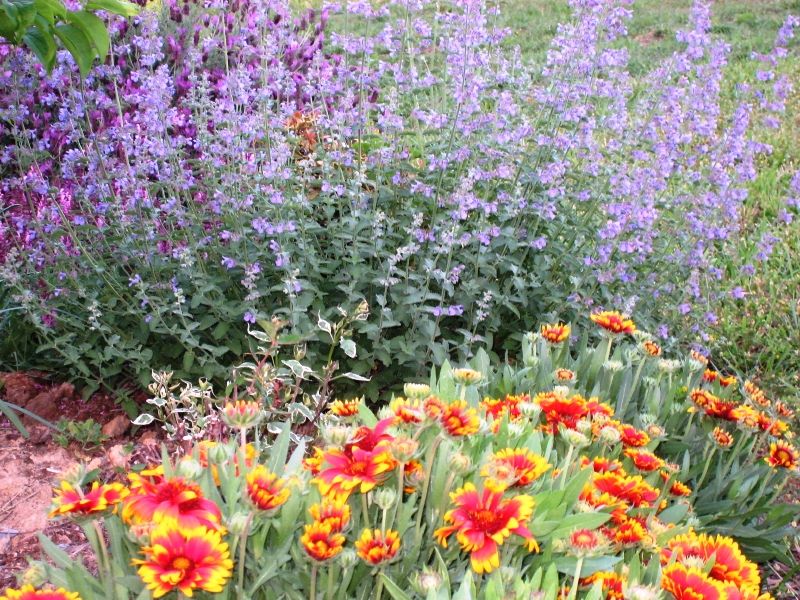
That same nepeta in the above photo is also in the next photo. In this instance, the color and size of the nepeta buffer two color schemes that wouldn't work together. Actually, these gaillardia were mislabeled as yellow and turned out to be orange and gold. Since I have now moved the rose perennials, I am expanding the gaillardia in this section. I learned to love this gaillardia as it bloomed almost non-stop all summer. Even the seed heads looked good for a long time, so deadheading wasn't mandatory to keep up appearances.


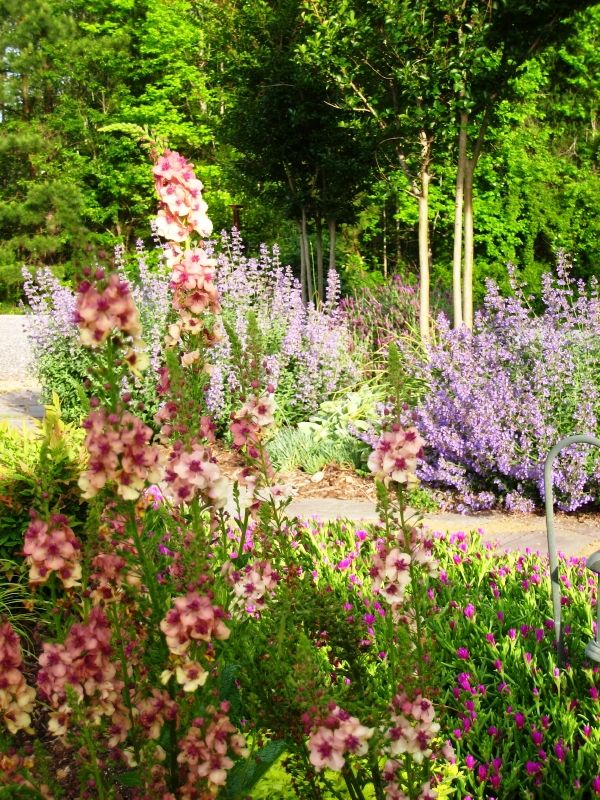
The verbascum in the following photo has been in place for two years. It didn't perform too well at first, but in 2008, it was looking good, with at least three rounds of blooms. It is growing at the junction of the outer garden path and the flagstone walkway to our front garden gate. Once again, you can see the nepeta 'Six Hills Giant' in the background across the walkway.

I finally had to move the largest nepeta as I was constantly shearing it back as it grew quickly over the walkway. I'll be redesigning that area in spring 2009, using something less likely to overflow onto the walkway.


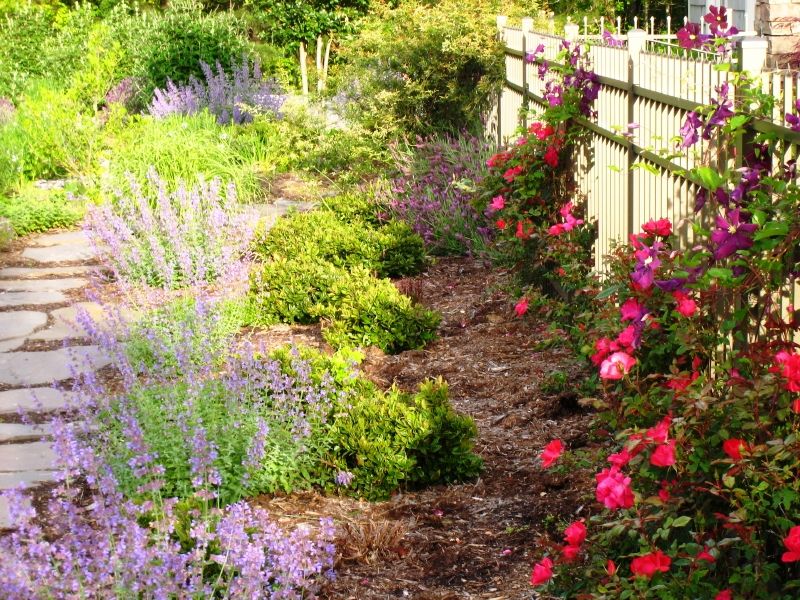
In the next photo, nepeta 'Walkers Low' is used for continuity along one side of the outer garden path. I prefer this nepeta for edging a walkway as the foliage spreads wide, but stays low, creating a nice ground cover.


Those are carrisa hollies outside the fence and Knock Out® roses inside the fence. Purple clematis is growing along the fence in this section. The hollies and roses were planted by the landscaper who installed our fence. The deer didn't touched the roses (that can be reached through the fence) until late August.

The design of this garden area is still underway. This fall, I planted Dutch iris 'Telstar' and allium 'Purple Sensation' along with the nepeta to add more color in the border for spring.

Larkspur seeds were sown along the fence line in October and the seedlings have already emerged. The larkspur is deer resistant. I'm excited about creating a cottage garden look with the mix of irises, allium, nepeta, roses and clematis.

While the nepeta x faassenii varieties like hot, dry conditions and well draining soil, there is a subsessillis variety that is supposed to be suitable for moist areas. I have the susessillis in blue and rose. I'll have to wait until summer of 2009 to report on how well these perform.

If you are looking for a plant with the following attributes, consider nepeta 'Six Hills Giant' or 'Walkers Low' for a mixed border or perennial garden. Nepeta is a favorite for honey bees, butterflies and hummingbirds.

Zones 3-8
Full sun
Deer resistant
Rabbit resistant
Japanese Beetle resistant
Drought tolerant
Long bloom season
Easy care (cut back at the end of winter and again after each bloom)
Easy to divide (divide by shovel)


Photos and story by Freda Cameron