Favorite Deer & Drought Tolerant Perennials

As I watch the flower garden emerge from winter into spring, I look for signs of the drought survivors. While our area of North Carolina is technically still in a drought, our lakes are finally full again from recent rainfalls. From last summer and through the winter the perennials stood up to the test of the drought tolerance. Since most of my plantings were new in spring/summer 2007, I'm pleased to report the drought tolerant successes of perennials -- that did not receive supplemental watering after the drought set in. These perennials were watered when first planted in April, May and June, which helped to get them established prior to the drought. Even drought tolerant plants need water to get established. Thereafter, these perennials are fairly carefree.

If you've followed my blog over the last year, you know that deer tolerance is also a requirement for my outer garden. This list of favorites also includes perennials that aren't touched by deer at all in my garden. Not even tasted and rejected (like some other plants); not even trimmed by deer at all.

I'm focusing on the top personal favorite deer and drought tolerant perennials in this blog. I'll talk about shrubs and ornamental grasses in the future. As an added bonus, these perennials are also loved by butterflies.

Coreopsis 'Creme Brulee'
Deer tolerant
Drought tolerant
Attracts butterflies
Perennial


There are little patches of green at the base of all of the coreopsis 'Creme Brulee' that I planted last year in the outer garden. There are literally hundreds of blooms all summer on this perennial. I sheared it back when the blooms faded and got another light bloom. My favorite tool for trimming a plant with this many blooms is a cordless Black & Decker HedgeHog cordless trimmer.

The verdict is still out on the pink/rose varieties ('Heaven's Gate' and 'Limerock Ruby') of coreopsis. I'm still watching for signs of life. Here's a photo taken while the 'Creme Brulee' was in bloom last summer.


Agastache 'Blue Fortune'
Deer tolerant
Drought tolerant
Attracts butterflies
Attracts bees
Attracts hummingbirds
Perennial


In the last week, the clumps of 'Blue Fortune' have come on strong. The perennials look hardy and it looks like the width of each plant has increased significantly to help fill in the bare spots in the garden. I am anticipating a strong showing from this butterfly magnet. The lilac/blue color works well with companion plants that bloom yellow, red, white, or orange.


Nepeta
Deer tolerant
Drought tolerant
Attracts butterflies
Attracts bees
Perennial


Nepeta is my "go to" plant! When I want a perennial that is easy to grow, provides a bloom season from spring until frost, is semi-evergreen, is drought tolerant, is deer tolerant, attracts bees, attracts butterflies and has beautiful soft blue color and fragrant foliage...this is it! Did I mention that it performs well the first season? Yes, it's near perfect to me.

I am in the process of expanding my edging along the outer gardens paths with nepeta. I have two varieties in the "dry" areas. Those are 'Six Hills Giant' and 'Walkers Low'. 'Walkers Low' doesn't get as tall as 'Six Hills Giant' but both need a lot of space -- allow 2-3 feet per plant. I have another variety, Nepeta Subsessillis, that works in moist soil. It is also coming back right now and I expect great things from that one. I'm on the look out for other varieties of nepeta, especially if I can introduce other colors of nepeta.

Looking through the nepeta:


Lavender 'Otto Quast'
Deer tolerant
Drought tolerant
Attracts butterflies
Attracts bees
Evergreen in zone 7
Perennial


I just love lavender. My favorite is 'Otto Quast' used throughout our garden. It blooms heavily in the spring. I shear it back and it has another lighter bloom in the summer. Here in our zone 7 of North Carolina, it is evergreen. The foliage is a bit grey, but still provides great winter interest in the garden when the other perennials have retired to the ground. If it bloomed as long as the nepeta, this would be another "go to" plant. It doesn't like overwatering, so always plant this one high and dry -- which makes it a great drought tolerant plant.


Perennial Heliotrope
Deer tolerant
Drought tolerant
Attracts butterflies
Attracts bees
Perennial


This is nothing like the fragrant annual heliotrope. This is a ground-covering flowering, creeping perennial heliotrope. It is difficult to find at plant nurseries and fortunately, I purchased quite a lot of it several years ago. This perennial has been with me for two years now. One plant goes a long way! It blooms non-stop from late spring until frost. Use it in places where you would plant 'Homestead Verbena'. I must say that I have doubts that I'll ever be able to REMOVE it from the garden, so beware of that one downside. It will fill in the bare spots in your garden in one season. It's beautiful at the feet of tall plants.

If you want to track this one down, here's the official name: Heliotropium amplexiacaule 'Azure Skies'.


Salvia greggii 'Navajo Red'
Deer tolerant
Drought tolerant
Attracts butterflies
Attracts hummingbirds
Perennial


This is an evergreen (in my garden zone 7) shrubby 3x3 ft salvia. It blooms almost all summer. It does appreciate a little afternoon shade. I have it planted on a bank where a weeping willow gives it dappled shade from the late western sun. I wait until late spring to trim it back. I have other salvias in my garden, but this is my new favorite.


Hardy Ice Plant
Deer tolerant
Drought tolerant
Evergreen in zone 7
Perennial


Another wonderful sun-loving, deer tolerant plant is the hardy ice plant (delosperma cooperii). There are so many reasons to love this little plant! It is evergreen here in our zone; the blooms sparkle in the sunlight and close up at night; it spreads easily without being invasive; pinch off a sprig and just stick it in the soil to propagate. I have this edging our sidewalk and wish I had planted it on both sides. I've been pinching and planting sprigs all during the fall, winter and spring and those have rooted.


I have other "honorable mentions" such as verbena Bonariensis (tall and airy, light purple verbena). It's perfect for deer and drought areas and it comes back in my garden like a perennial. It blooms all summer for me. I don't have good photos of mine from last year. In some gardens, it isn't considered a perennial, but it does self-seed.

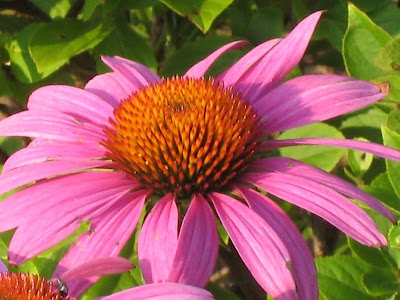
I'm keeping an eye on all the new coneflower varieties that I planted last year. The orange ('Sunset' and 'Sundown') are showing signs of life. I'm yet to see the pale yellow varieties emerge. Hopefully, I'll have more drought and deer tolerant favorites to add as the season continues.

Happy Gardening!
Cameron

The Garden Promenade

Several times a day (in nice weather) I find myself wandering through the flower garden. We even ask our greyhound if she wants to "promenade" which has come to mean going out to see what's happening in the garden. I look for signs of green at the base of perennials and watch for blooms on the spring bulbs. I pull weeds as I go... as though it's just part of the walk, rather than a chore.

To truly enjoy a garden, I believe you must go out and get IN the garden rather than view it from afar. As spring emerges, I find plants changing within only a few hours. In my mind, I start re-arranging the garden; I look at the health or attractiveness (or lack of) among the current plants; I think about the colors or kinds of plants that I want to increase or decrease.

Rather than keep a written journal, I tend to document the garden through photographs. Right now, I can go back to last year's photos to help me remember how the perennials, ornamental grasses and annuals looked.

To allow us to stroll the garden, the entire family has participated in the creation of paths, points of interest and plantings. Although the outer garden was just established in 2007, the feeling of a garden structure was obvious early on.

To provide perspective, the outer garden is outside the fence in the front (south) and east side of the house. To the left is our dry stream bed with a little arched bridge to the meadow. To the right, the path cuts back to the side of the house, through the butterfly garden; the path then leads past the back of our waterfall, then to the fragrance garden, a patio and the pool behind the house.


All of the following garden path photos were taken in September 2007, when much of the garden blooms had already peaked. We are still in extreme drought. At the time the photos were taken, we were in the middle of an exceptional drought (worse). We had just experienced a brief rain that provided a nice color for the dried out mulch.

This is the path in front of the fence. Plants that tolerate moisture are planted along the left side of the stepping stones as the rain runoff from the meadow drains here. Then, the rain runoff slowly drains to the far end of this path to the dry stream bed.


Along the front path, we have little points of interest such as the sundial and the acorn finial.


This is a view of the dry stream bed from the front garden stepping stones.


This is a view of the dry stream bed taken from the driveway, looking back toward the front garden.


From this view, you can see the willow tree (bench below) looking from the butterfly garden to the corner turn into the front garden. The willow was planted in the fall 2005 when the house was built. It benefits from the water runoff from the meadow above. In the forground, there are stripped stems of bronze fennel that served as a host plant for swallowtail butterflies. Behind the bench is a mass planting of salvia greggii 'Navajo Red' which serves up hummingbird nectar. Those salvia are evergreen here in NC and are like small shrubs (3x3) when mature.


Moving backward in the butterfly garden (on the left), the birdbath is actually serving as a butterfly beach. In the summer, we add sand (keep it moist) and a touch of salt for the butterflies. The chaste tree on the left is a favorite. It is surrounded by agastache, asclepias tuberosa (host plant for Monarchs), coneflowers, coreopsis, crocosmia, nepeta, pineapple sage (for hummingbirds), rubeckia, verbena and a few ornamental grasses (miscanthus, clumping bamboo). On the right side are hollies (bees love those when they bloom in spring), osmanthus fragrans, lilac, baptisia, monarda, nepeta and other ornamental shrubs and perennials. When the perennials are in bloom, this area has a bright look with orange, red, blue, purple, and yellow.


A Red-banded Hairstreak pauses on the vitex (chaste tree):


A Monarch enjoys the agastache 'Blue Fortune':


Turning around in the butterfly garden to look toward the back of the house, the garden path winds around behind the waterfall (mound is planted with cryptomeria, cotoneaster, and ornamental grasses). The path leads to the fragrance garden.


The fragrance garden is planted with sweet bay magnolia, gardenia, ginger, akebia, jasmine, buddleia, willow, monarda, osmanthus fragrans, colocasia, brugmansia and heuchera. The green, lush foliage and evening fragrance makes for a wonderful dining patio (family built). The arbor, covered with akebia and jasmine, leads to the pool and deck in the backyard.


I hope you enjoyed the garden promenade. As the growing season progresses and there is color in the garden, I'll post a follow-up promenade.

Happy Gardening!
Cameron

In the Pink

When it comes to perennials and blooming shrubs, it seems that there are so many colors of pink that work well together in my flower garden. In my deer-resistant outer garden, there are some favorites that I intend to repeat this year throughout the garden. I lean toward preferring deep pink to purple/lavender tones.

One of my favorite shrubs is spirea 'Neon Flash'. I planted three last summer and they didn't disappoint with the display of pinkish blooms as a partner for the deep pink echinacea blooms. The deer didn't touch the spirea. The first bloom on each echinacea was munched, but then left alone for the rest of the summer and fall.


For a totally deer-resistant combination, I love bee balm (monarda 'Blue Stockings' or 'Marshall's Delight' are good colors) with butterfly bush (buddleia 'Pink Delight').


Lantana 'Miss Huff' does well as a perennial in my garden. The deer don't touch this flowering shrub. Once it starts blooming in early June, it doesn't stop until frost. It blooms and blooms without deadheading. It is a butterfly magnet. I have three of these lantana near our driveway, but I intend to find space in the butterfly garden so that this nectar plant is closer to the host plants for butterflies. I think this shrub with deep pink coneflowers and yellow snapdragons.


Although I can't seem to find a photo of my ice plant (delosperma cooperi), I highly recommend it as a groundcover, evergreen (in zone 7), deer and drought tolerant perennial. It is an easy plant to propagate. Just pinch off a sprig and stick in the ground! The sparkling fushia blooms open during the day and close in the evenings.

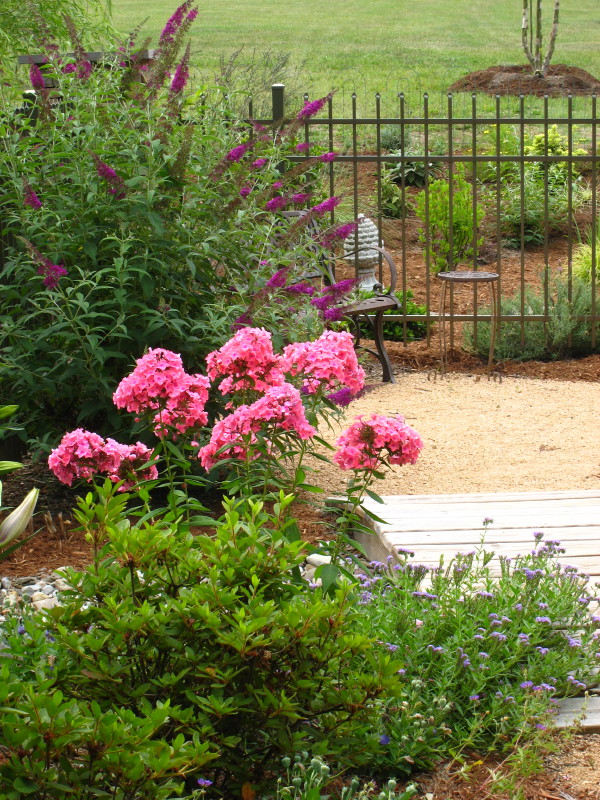
Inside the cottage garden fence, I have a few favorite pinks that aren't deer tolerant. Encore Azalea, garden phlox and dianthus provide pink inside the garden fence.


The pale pink dianthus shown in the above photo also edges one of our pathways (in the background). The dianthus provides early spring blooms over a long period of time. The fragrance is very sweet and spicy. I've had trouble growing this outside the fence as either deer or rabbits pull dianthus plants out of the ground.

Happy Gardening!
Cameron